
2021

A headline for this holiday season
Tara Bahrampour, The Washington Post
2021.12.29
Belfast
2021.11.14
You don’t need to have grown up in, let alone escaped The Troubles in
Northern Ireland to embrace the rose-colored sentiment of Belfast, Kenneth Branaugh’s pseudo-autobiographical feature. To get
a bit wistful you only need to have been raised, as I was, in a household committed
to Van Morrison. As a tenet of parental responsibility, a generation of
fathers encoded Morrison’s whiskey-soaked, folk-jazz
grovel onto their children’s memories. This subtext
— for a specific set of Millennials
— is reaching full nostalgic expression as the succesor generation ascends into middle age.
“VanMo could really rock,” my father once told me as the singer spoken-worded harmonic throat syrup over “Have I Told You Lately.” My disgust was visceral. The sentiment was almost as off-putting as the nickname, “Van the Man.” No one rocked in the late-90s, if they ever did, and anyway he had said the same thing about Elton John when I’d pantomimed gagging in response to the ubiquity of “Candle in the Wind.” That song had carried the radio waves for almost year after Lady Di’s death, as inscribed into my memory as the firm bench seats of the Volvo we carpooled to middle school in. Upon hearing my father defend that saccharine posh, I’d silently prayed for Diana’s fate.
I was still getting acquainted with my early-teens, and in no state to abandon the sanctuary of punk-grunge realness. That was an angry safe space, mostly for kids whose parentally supplied comforts afforded them discontent as a hobby. We’d inherited the voice of our elder siblings era, an off-standish snark who screeched lines like “hey, wait, I’ve got a new complaint.” We’d nodded ours heads, sometimes violently, to indulgent pop angst. And then, once we’d mined that aggressive diffidence for all its rebellious currency, we cut our hair and postured about excesses of money and problems, of which we had neither. It was an appropriate response to suburban ennui; Boredom and trees were our generational strife, our martyrs all handed down.
Which is to say that Van Morrisons’s “Jackie Wilson Said,” predates any cultural awakening I can claim to remember. It was force-fed like whole milk at the dinner table, or quiche, or any other inscrutinable existence that fades into memory with consciousness. It was there from the start, along with my father’s bad dancing, which can only be described as a mustachioed flamingo doing The Twist. It holds all the familiarity of a childhood basement—an evolving, musty constant with occasional surprises.
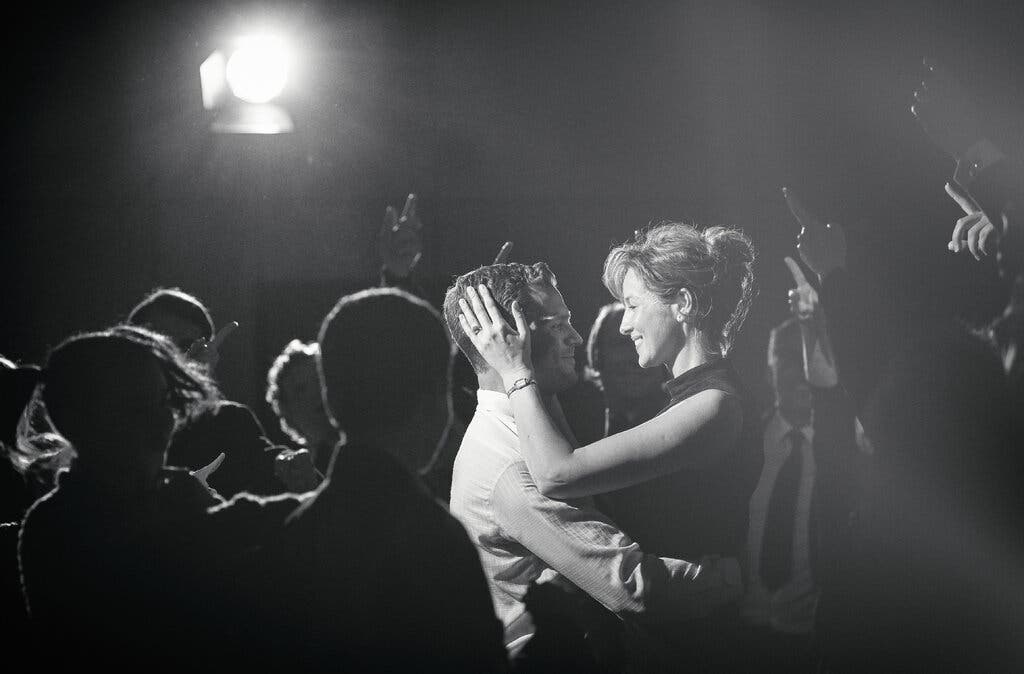
In Belfast, Branaugh deploys “Jackie Wilson Said,” along with most of the Morrison catalog, liberally. JWS appears midway through the film, hoisting aloft the soon-to-be reciprocated pinings of Buddy, the film’s boy protagonist (and Branaugh stand-in). The “da-da-da dah…” intro crescendos out of a scene change, part-rallying cry, part-palette cleanser, its mutable non-wordness simultaneously nostalgic and optimistic. On first listen, you only hear the intonnations of Morrison’s voice, the “blabbity-blab” that seems more child banter than coherent speech. To that end, “Jackie Wilson Said” is about meaningless phonetic contrivances as much as any words Jackie Wilson purportedly spoke. The whole thing spins on the precipice of unspooling, the saxophone riffs propelling it off a course that Morrison recharts with indecipherable proclamations. He drops the bottom out of hea-von and passes through the pearly gates. He sings “smile” in definance of any combination of letters. He dances through strings of syllabic detritus that cohere into affective meaning. His heart goes “boom boom boom,” and he let’s it all hang out.
Throughout the song, licentious horns blare overtop lyrics. As a child it was hard to discern the words from sounds, and I certainly wasn’t reading the liner notes. As an adult, I’ve extracted meaning from the Morrisonian babel, with some disappointment. The words are not necessarily cloying, just disambiguated. They hint at fresh love, but not first love. They’re giddy for a “brand new smile.” Yet, they’re also ladden with the presumption that the audience is familiar enough with early stage love to know that it may not be their last. The lyrics aren’t jaded. Morrison’s voice, and his audience, are.
In the retroactive assessment of Branaugh’s childhood, The Troubles are a matter of historical and biograpahical convenience as much as they are a plot device. The backward gaze isn’t set in the sepia tones, or the quant Irish streetlife. Its the soundtrack — much of it comprised of songs a half-century old — that soften edges. Van Morrison is the context.
“VanMo could really rock,” my father once told me as the singer spoken-worded harmonic throat syrup over “Have I Told You Lately.” My disgust was visceral. The sentiment was almost as off-putting as the nickname, “Van the Man.” No one rocked in the late-90s, if they ever did, and anyway he had said the same thing about Elton John when I’d pantomimed gagging in response to the ubiquity of “Candle in the Wind.” That song had carried the radio waves for almost year after Lady Di’s death, as inscribed into my memory as the firm bench seats of the Volvo we carpooled to middle school in. Upon hearing my father defend that saccharine posh, I’d silently prayed for Diana’s fate.
I was still getting acquainted with my early-teens, and in no state to abandon the sanctuary of punk-grunge realness. That was an angry safe space, mostly for kids whose parentally supplied comforts afforded them discontent as a hobby. We’d inherited the voice of our elder siblings era, an off-standish snark who screeched lines like “hey, wait, I’ve got a new complaint.” We’d nodded ours heads, sometimes violently, to indulgent pop angst. And then, once we’d mined that aggressive diffidence for all its rebellious currency, we cut our hair and postured about excesses of money and problems, of which we had neither. It was an appropriate response to suburban ennui; Boredom and trees were our generational strife, our martyrs all handed down.
Which is to say that Van Morrisons’s “Jackie Wilson Said,” predates any cultural awakening I can claim to remember. It was force-fed like whole milk at the dinner table, or quiche, or any other inscrutinable existence that fades into memory with consciousness. It was there from the start, along with my father’s bad dancing, which can only be described as a mustachioed flamingo doing The Twist. It holds all the familiarity of a childhood basement—an evolving, musty constant with occasional surprises.
In Belfast, Branaugh deploys “Jackie Wilson Said,” along with most of the Morrison catalog, liberally. JWS appears midway through the film, hoisting aloft the soon-to-be reciprocated pinings of Buddy, the film’s boy protagonist (and Branaugh stand-in). The “da-da-da dah…” intro crescendos out of a scene change, part-rallying cry, part-palette cleanser, its mutable non-wordness simultaneously nostalgic and optimistic. On first listen, you only hear the intonnations of Morrison’s voice, the “blabbity-blab” that seems more child banter than coherent speech. To that end, “Jackie Wilson Said” is about meaningless phonetic contrivances as much as any words Jackie Wilson purportedly spoke. The whole thing spins on the precipice of unspooling, the saxophone riffs propelling it off a course that Morrison recharts with indecipherable proclamations. He drops the bottom out of hea-von and passes through the pearly gates. He sings “smile” in definance of any combination of letters. He dances through strings of syllabic detritus that cohere into affective meaning. His heart goes “boom boom boom,” and he let’s it all hang out.
Throughout the song, licentious horns blare overtop lyrics. As a child it was hard to discern the words from sounds, and I certainly wasn’t reading the liner notes. As an adult, I’ve extracted meaning from the Morrisonian babel, with some disappointment. The words are not necessarily cloying, just disambiguated. They hint at fresh love, but not first love. They’re giddy for a “brand new smile.” Yet, they’re also ladden with the presumption that the audience is familiar enough with early stage love to know that it may not be their last. The lyrics aren’t jaded. Morrison’s voice, and his audience, are.
In the retroactive assessment of Branaugh’s childhood, The Troubles are a matter of historical and biograpahical convenience as much as they are a plot device. The backward gaze isn’t set in the sepia tones, or the quant Irish streetlife. Its the soundtrack — much of it comprised of songs a half-century old — that soften edges. Van Morrison is the context.